Rechercher dans ce blog

Sunday, February 28, 2021

Here's why 2021 could be a big year for labor unions - CNN

And although the pandemic made things worse, America's wealth gap has largely been expanding since the 1980s.
Among the many contributing factors: Far fewer jobholders have a seat at the table in negotiating with upper management than they did decades earlier. In 2020, union membership hit a new modern low.
"There is a direct correlation that when union membership is down, economic inequality is up," said Kent Wong, executive director of the UCLA Labor Center, a department that studies labor and economic issues.
In cities across the US, and between the walls of some of the world's largest enterprises, there is a swelling of union organizing activity that has been propelled by the pandemic and the recession.
Frontline workers — nurses, teachers, meatpackers, grocery-store clerks, delivery drivers and produce workers — protested for workplace protections and paid sick leave. In Big Tech, where multibillion-dollar companies have benefited from stay-at-home mandates, trailblazing unionization efforts are accelerating at Amazon and Google.
And in Washington, D.C., labor just potentially gained a powerful ally in President Joe Biden, who has pledged to be "the most pro-union president you'd ever seen."
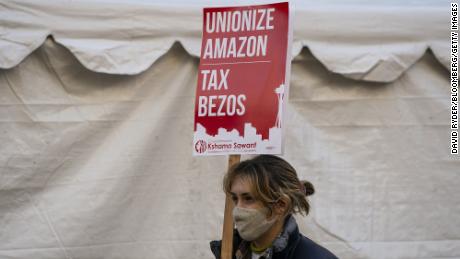
A demonstrator holds a sign reading "Tax Bezos" during a protest outside Amazon.com headquarters in Seattle, Washington in November.
"I do think that the current moment provides an opportunity for unions that has not existed in many, many years," Wong said, "and that there is a growing national consensus that there needs to be dramatic changes to ensure that the economy does indeed work for everybody and not just Wall Street."
He added: "There is a sea change with regards to issues involving workers' rights."

A 'level of desperation'

Generally, economic downturns are bad for union organizing.
"For a long time, economists have argued that workers are less likely to go on strike and push for things like unions in bad economic times," said Ileen DeVault, a professor of labor history at Cornell University's ILR School. "Employers could fire you and replace you with another worker. Workers had more power when unemployment rates are low."
However, that hasn't always been the case. During the Great Depression, unemployment reached as high as 25%. With the economy that bad, many workers assumed they'd likely lose their jobs anyway — so they figured they might as well come together and potentially gain protections via unionization, DeVault said.
"You reach a level of desperation where that doesn't matter as much," she said. "I think that's part of what we're beginning to see today."
In fact, the Great Depression fueled the single largest union push in US history, said Wong, of the UCLA Labor Center.
There are some parallels that can be drawn between then and now, when the pandemic has deepened the divide between the haves and the have-nots.
In the Depression era, amid the staggering unemployment rates and the considerable economic inequality, a tremendous amount of organizing activity took place, he said, adding that a mass social movement pushed President Franklin D. Roosevelt to use the power of the federal government to improve the rights of workers.
A similar phenomenon appears to be playing out now.

State of employment

The pandemic has put a spotlight on workers' rights issues and accelerated an organizing movement that's been slowly building in recent years — with actions such as the teachers' strikes in 2018 and the "Fight for $15" movement, DeVault said.
"For quite a while, workers have been really frustrated with not having a voice at their workplaces, and for teachers then, it just reached a breaking point," DeVault said. "In that way, I don't think [these efforts] are new."
What is new is that other groups of workers such as nurses, gig workers and warehouse employees are being revered as critical during the pandemic while the stark inequalities and their vulnerable situations — such as unsafe working conditions, low pay and lack of access to health care — are being exposed, said Celine McNicholas, director of government affairs and labor counsel for the Economic Policy Institute.
"This is not a moment where these issues can be ignored," she said.
In 2020, nearly 14.3 million workers belonged to a union, 321,000 fewer than the year before, according to the US Bureau of Labor Statistics' annual union membership report released Jan. 22.
When the BLS started tracking the data in 1983, more than 17.7 million workers were unionized. And despite a modest uptick during the Great Recession — an increase that labor experts attribute to public-sector organizations — the levels have steadily declined to where they are at today: a historic modern low.
The outsourcing of manufacturing jobs, coupled with economic downturns, political influence, corporate actions, and the increasingly arcane and anti-union nature of the nation's labor laws have all played a role in decreasing union density in recent decades, said labor historian Nelson Lichtenstein, a professor at the University of California - Santa Barbara, and author of the book, "State of the Union: A Century of American Labor."
A Gallup poll released in September 2020 showed that 65% of Americans surveyed were in favor of labor unions, matching a high notched in 2003 and representing a significant increase from a Great Recession-era low of 48%.
"We're looking at numbers that are so far afield from that," McNicholas said. "That is a lot of space between workers getting what they want in a system that provides that choice in a meaningful way and a system that we have."

From blue-collar to Big Tech

At Alphabet, the parent company to tech giant Google, a grassroots workers organization that formed without federal ratification has grown to more than 800 members since its early January launch.
Called the Alphabet Workers Union, the organization seeks to provide an amplified voice for a wide swath of Alphabet employees — including full-time workers, part-timers, vendors and contractors — and create a power structure for those diverse concerns and desires to be heard.
"I think that the recognition we've gotten from our coworkers, who have taken a real risk to join and support us, and from external forces — especially including unions and other labor movements from beyond tech — is really a validation of our underlying message: That unions are for everyone, and tech is no exception," Alex Gorowara, a Google software engineer and Alphabet Workers Union founding member.
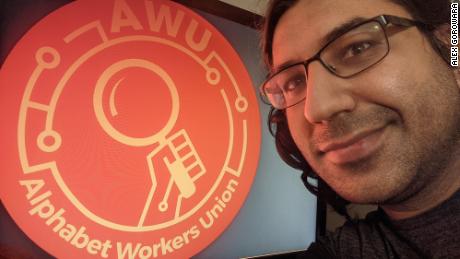
Alex Gorowara, a Google software engineer and one of the co-founders of the Alphabet Workers Union.
The tensions started to hit a breaking point in late 2019 when Google fired four employees who had been active in labor organizing. The National Labor Relations Board has since alleged that Google violated labor laws when firing two of those employees. Google disputes those allegations.
"We strongly support the rights our employees have in the workplace, and open discussion and respectful debate have always been part of Google's culture," Google said in a statement.
And at Amazon, a historic vote is underway at the e-commerce giant's Bessemer, Alabama, warehouse. There, more than 5,800 employees are voting by mail as to whether they should join with the Retail, Wholesale and Department Store Union and form Amazon's first US union.
"It is not surprising that recent forces have come to lead to an organizing campaign in Amazon's Alabama plant," said Kenneth Dau-Schmidt, Carr Professor of Labor and Employment Law, Indiana University-Bloomington. "Amazon workers have had long-running concerns about the speed of work, safety and pay. During the pandemic, these concerns have only increased."
In addition to ongoing concerns about working conditions, especially during the pandemic, benefits have also slipped away. The company nixed a policy of unlimited time off and wound down its $2-per-hour hazard pay increase.
"The company is making money hand over fist," he said. "It is not unreasonable for the workers to expect to get higher wages and better benefits."
Amazon said it invested $2.5 billion in employee bonuses and incentives during 2020 atop its $15 minimum wage. And at the Bessemer site, which opened in March, the company created thousands of full-time jobs that start at $15.30 per hour and include a variety of benefits, Amazon spokesperson Heather Knox said in an emailed statement.
"We don't believe the RWDSU represents the majority of our employees' views," Knox said. "Our employees choose to work at Amazon because we offer some of the best jobs available everywhere we hire, and we encourage anyone to compare our total compensation package, health benefits, and workplace environment to any other company with similar jobs."
If successful, the Amazon employees would join a new batch of collective organizations at places such as cannabis companies and media organizations like Gawker, Buzzfeed, Vice, Vox and the New Yorker. The evolution from blue-collar card holder to unionized budtenders and journalists serve as a reflection of how industry in America has changed during the past century.

'People were scared that they would be fired'

Recent unionization rumblings are not unique to Big Tech or media. Industries at the frontlines of the pandemic — like teaching and nursing — have also picked up organizing activity in the last year.
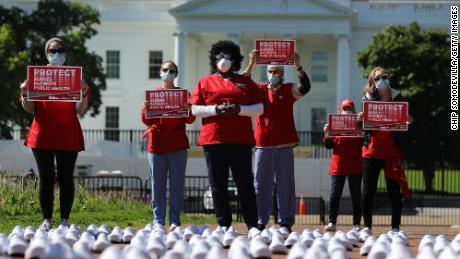
Members of the National Nurses United stand in protest across from the White House, seeking workplaces protections. The empty shoes represent nurses that they say have died from Covid-19.
In late 2019, Kerri Wilson sat in a room with about a dozen fellow nurses as they discussed unionizing at their Mission Hospital in Asheville, North Carolina.
Earlier that year, HCA Healthcare (HCA), a hospital conglomerate based in Nashville, had acquired Mission Hospital, and in the months that followed, operational and staffing cutbacks drew public outrage from nurses, patients and lawmakers, the Asheville Citizen-Times reported.
Privately, the nurses explored organizing.
"A lot of folks were resistant in the beginning — more out of fear," Wilson said in an interview with CNN Business. "We're in the South, and unions aren't much of a thing here. And people were scared that they would be fired."
Wilson, 34, has been a nurse for eight years, five of those at Mission Hospital. She works in the cardiology unit, serving high-acuity patients. The Asheville native was drawn to her hometown hospital as it often landed on many top state and national hospital rankings — especially for cardiology care.
"I want to be able to take care of my patients the way they deserve," she said.
But when the pandemic hit, nurses felt like the conditions deteriorated, and personal protection equipment was in short supply, she said, adding that the situation emboldenedthose who sought to organize. (A Mission Health hospital spokesperson said HCA Healthcare acted very early on at its hospitals to provide equipment, conduct screenings, assign stewards to ensure proper PPE use and fitting, and add nurses.)
After a monthslong campaign, nurses at Mission Hospital voted to unionize in September 2020. National Nurses United, one of the nation's largest unions that now represents Mission Hospital nurses, described the organization of about 1,800 nurses at Mission Hospital as the largest hospital unionization in the South since 1975.
And it's not just happening in Asheville: During the Covid-19 pandemic, nurses throughout the country have contacted National Nurses United at a significantly higher rate than before, said Zenei Triunfo-Cortez, a Bay Area registered nurse and president of National Nurses United.
"They saw that we were advocating for nurses' welfare, we were advocating for our patients' welfare," she said. "They wanted to join an organization that did just that."

A potential ally in the White House

A day before the 2020 election, Joe Biden told a crowd of union members in Beaver County, Pennsylvania, that he'd be "the most pro-union president you've ever seen."
The Scranton, Pennsylvania, native has long garnered support from working-class Americans, but after four years of "fierce anti-union, anti-worker policies" enacted during the Trump administration, labor unions mobilized behind Biden in key battleground states such as Michigan, Pennsylvania and Wisconsin, UCLA's Wong said.
"These were the people who got Joe Biden elected," he said.
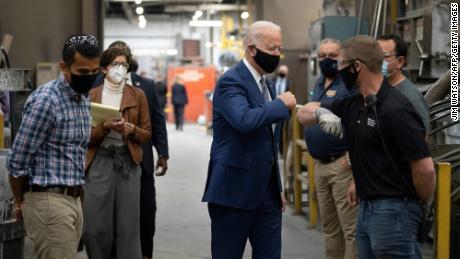
On the campaign trail Joe Biden visited with union members in an aluminum factory in Manitowoc, Wisconsin in September.
Biden's pro-union campaign plan included forming a cabinet-level working group in the first 100 days of the presidency to increase union density. Biden also promised to require federal contractors to sign neutrality agreements committing to not run anti-union campaigns. Depending on how it's written, such a policy could have a ripple effect on Big Tech, which has resisted unionization efforts in the past. Companies like Amazon, Google and Microsoft contract with the federal government.
A White House spokesperson declined to comment on specific details or a timeline for when Biden might enact that policy. In early February, he tweeted, "The policy of our government is to encourage union organizing, and employers should ensure their workers have a free and fair choice to join a union." (That said, Biden has yet to comment publicly on the unionization effort underway at Amazon — rankling some union supporters.)
In the early days of the new presidency, Biden signed an executive order that restored collective bargaining power to federal employees, and the administration took aim at the National Labor Relations Board, ousting Trump-appointed officials such as Peter Robb, the board's general counsel. Robb, a longtime management-side lawyer, most notably served as the lead attorney in the Reagan Administration's watershed case that decertified the Professional Air Traffic Controllers Organization in 1981. (The Reagan administration's firing of more than 11,300 striking air traffic controllers and the subsequent PATCO takedown have been viewed as catalysts for a decline in union activity.)
Biden on February 17 nominated Jennifer Abruzzo, the Communication Workers of America's special counsel for strategic initiatives, to replace Robb.
Labor advocates are viewing these actions and other nods — including Biden tapping Marty Walsh, the Boston mayor and former union leader, as labor secretary; and Biden having a bust of labor leader Cesar Chavez behind the Resolute Desk in the Oval Office — as signs that their causes will be championed.
"It's not just an election campaign promise," said Triunfo-Cortez, of National Nurses United, which received the backing of Biden and his wife, Jill, during the Mission Hospital unionization. "It gives us a lot of renewed hope for union organizing."

Consequential legislation

But just how much the Biden administration can accomplish beyond executive action and rulemaking remains to be seen.
"I think without major changes in the law, you're not going to see large increases in union organizing into the future," Dau-Schmidt said.
One legislative vehicle in the wings is the union-friendly Protecting the Right to Organize (PRO) Act, which was reintroduced by Democrats earlier this month. The bill includes a slew of provisions that proponents say will make it easier for workers to form unions, conduct strikes, and bargain for better wages and working conditions. The PRO Act could significantly upend current labor law by allowing for actions such as NLRB-levied fines and potential civil penalties for labor rights violations; the weakening of states' "right-to-work" laws, which say workers cannot be compelled to join a union as a requirement of their job; and -— consequential to the freelance and gig economies — the implementation of an "ABC" test for determining if a person is an employee or contract worker.
That said, that bill and other large legislative vehicles might not be filibuster-proof, said the EPI's McNicholas.
"I don't know that it is completely unpassable, but I think that getting to the 60 [votes required in the Senate] is obviously a heavy lift," she said.
That's not to mention the considerable opposition from business executives, shareholders and a host of organizations such as the National Retail Federation, the National Federation of Independent Businesses, the American Society of Journalists and Authors, and the US Chamber of Commerce.
The Chamber, which has campaigned against the PRO Act since when it was first introduced in 2018, described it as a "grab-bag of harmful policies."
"This legislation strips workers of their privacy, threatens private ballots, imposes California's disastrous independent contractor test, jeopardizes employers' right to free speech, and threatens the loss of a job should workers choose not to pay union dues," Glenn Spencer, the Chamber's senior vice president of employment policy, said in a statement posted earlier this month.
He added: "This bill is a threat to America's workers, employers, and our economy."
Biden also has expressed support for legislation such as the Fairness to Farm Workers Act and Domestic Workers' Bill of Rights, which advocates say would expand federal protections to agricultural and domestic workers. These types of workers often don't have a collective or a firm to bargain with, said Ai-jen Poo, who helms the National Domestic Workers Alliance, a non-union organization that advocates for home care workers, nannies, house cleaners and other domestic-centric employees.
"We are witnessing a full-blown depression within our workforce, with people struggling to survive; I know this is true throughout the economy," she wrote via email to CNN Business. "Workers must be a part of shaping our recovery, or we risk even greater inequality and fragility in our economy coming out of this crisis."

Let's block ads! (Why?)


"Here" - Google News
February 28, 2021 at 10:17PM
https://ift.tt/3aXSami

Here's why 2021 could be a big year for labor unions - CNN
"Here" - Google News
https://ift.tt/39D7kKR
Shoes Man Tutorial
Pos News Update
Meme Update
Korean Entertainment News
Japan News Update

New Urbane Cafe location opens in Visalia - KFSN-TV

takanadalagi.blogspot.com
FRESNO, Calif. (KFSN) -- Action News was in the neighborhood for the opening of a new restaurant in Visalia last week.

Urbane Cafe offers fresh salads and sandwiches made from scratch.


The restaurant is known for its focaccia bread -- which is baked fresh daily.

The family-owned business got its start in San Diego and began moving north from there -- with a cafe in San Luis Obispo.

The Visalia location marks the 21st store.


"You know, we decided it was a great opportunity for us to get a little bit more north," says Marketing Manager Caprice Kindgren. "We've heard great things about this city and we just really want to be a part of it."

Urbane Cafe is located along Mooney Boulevard and Beech Avenue in Visalia.

The restaurant also offers curb-side pick up and face masks are required.

Copyright © 2021 KFSN-TV. All Rights Reserved.

Let's block ads! (Why?)


"cafe" - Google News
February 28, 2021 at 11:35PM
https://ift.tt/3uHMWmD

New Urbane Cafe location opens in Visalia - KFSN-TV
"cafe" - Google News
https://ift.tt/2FkbMR3
https://ift.tt/3c4yPxW

Opinion | The Era of Vaccine Diplomacy Is Here - The New York Times

The coronavirus threat is global. So is the remedy.

It is only natural that the American government and the American people have focused on getting coronavirus vaccines to as many of its people as possible, with the most vulnerable first in line. But as the pace of domestic vaccination accelerates, two facts are worth bearing in mind.

One is that the pandemic will not be vanquished anywhere until it is vanquished everywhere. Several known coronavirus variants are making their way around the world, and epidemiologists know more will evolve so long as the virus continues to spread, potentially challenging the efficacy of existing vaccines. South Africa, for example, halted use of the Oxford-AstraZeneca vaccine when it showed “disappointing” results against a new, more contagious variant of the virus that has made landfall in the United States.

The second fact is that while more than 45 million Americans, nearly 14 percent of the U.S. population, have received at least one dose of vaccine, and most high-income countries have launched their own vaccination programs, the Think Global Health project of the Council on Foreign Relations estimates that only 7 percent of low-income countries had vaccinated anyone at all as of Feb. 18.

That is a yawning gap. Dr. Tedros Adhanom Ghebreyesus, the director general of the World Health Organization, has correctly described it as “another brick in the wall of inequality between the world’s haves and have-nots.”

The good news is that the gap is finally being addressed. Last week, a cargo plane landed in Ghana with 600,000 doses of vaccine developed in Britain and manufactured in India, the start of a program to deliver at least 1.3 billion shots to 92 low- and middle-income countries this year through Covax, an international effort backed by the World Health Organization.

Rahmat Gul/Associated Press

The effort has had a rocky start. Under the Trump administration, the United States pulled out of the W.H.O. altogether, and along with other wealthy nations it grabbed what vaccine it could for itself. But the Biden administration has moved quickly to rejoin the W.H.O. and has pledged $4 billion to the global vaccination drive. President Emmanuel Macron of France has further suggested that instead of money, wealthy countries should donate vaccine doses to African governments, sparing Covax the need to compete for existing supplies.

All this is just a start. The 600,000 doses that arrived in Ghana are barely enough to inoculate 1 percent of its population, and Covax will need a lot more money and help.

While conquering the virus is the obvious and primary reason for the United States to pitch in, there is also this: It is very much in America’s national interest not to cede a critical “soft power” advantage to autocratic rivals like Russia or China.

Poor countries will remember who came to their assistance, and when. Moscow and Beijing saw an opportunity early on, sending masks and protective gear to hard-hit countries last spring. Now, with low- and middle-income countries clamoring for vaccines, countries from Serbia and Algeria to Brazil and Egypt are getting doses from China and Russia. Serbia, in fact, is ahead of most countries in the European Union in the percentage of its population that has been vaccinated, in part because it’s one of the few countries where both Russian and Chinese vaccines are already available.

China has made sharing its homegrown vaccines a centerpiece of its “Belt and Road Initiative,” a global strategy to invest in more than 70 countries and international organizations. Beijing’s vaccine diplomacy has had its glitches, most notably the lack of verified information about the efficacy of its vaccines, but for many poor countries, China’s vaccines are far better than nothing. Recently, for example, China announced it would donate 300,000 doses to Egypt.

Russia claims it has orders for its Sputnik V vaccine from about 20 countries — including America’s southern neighbor, Mexico, which has contracted to receive 7.4 million doses between February and April. After a bout of Covid-19 in late January, President Andrés Manuel López Obrador of Mexico reported that he had received a warm phone call from President Vladimir Putin of Russia and that he had invited Mr. Putin to visit Mexico. At about the same time, the president and vice president of Argentina, Alberto Fernández and Cristina Fernández de Kirchner, both received their first jabs of Sputnik V.

India, among the world’s largest producers of generic medicines, has also moved to develop its own vaccines and to ship them abroad, in part as a counter to China’s outreach. Though India has a population of more than 1.3 billion, it has already sent 3.2 million free doses to neighboring countries and has contracted with a host of governments around the world to supply vaccines. One reason India can do this is that it’s producing more vaccines than it can currently distribute domestically. The U.A.E., which is vaccinating its residents faster than any country except Israel, has also begun donating Chinese-made Sinopharm to countries where it has strategic or commercial interests.

Vaccine diplomacy has drawbacks. Dr. Ghebreyesus of the W.H.O. has complained that too many countries and vaccine manufacturers are focused on making bilateral or selective deals, which pushes the poorest countries to the side. That is the advantage of the W.H.O.’s Covax initiative, and the Biden administration has made a good start in supporting it.

President Biden has assured Americans that most will be vaccinated by the end of summer. He should also assure them that it is very much in their interest, for reasons of morality, common sense and national interest, to be at the forefront of the global war against that vicious little spiked blob.

The Times is committed to publishing a diversity of letters to the editor. We’d like to hear what you think about this or any of our articles. Here are some tips. And here’s our email: letters@nytimes.com.

Follow The New York Times Opinion section on Facebook, Twitter (@NYTopinion) and Instagram.

Let's block ads! (Why?)


"Here" - Google News
February 28, 2021 at 11:00PM
https://ift.tt/3uPS1JE

Opinion | The Era of Vaccine Diplomacy Is Here - The New York Times
"Here" - Google News
https://ift.tt/39D7kKR
Shoes Man Tutorial
Pos News Update
Meme Update
Korean Entertainment News
Japan News Update

Café and museum to highlight hip-hop artists and activism – Daytona Times - Daytona Times

takanadalagi.blogspot.com

ADVERTISEMENT

The Hip Hop Hall of Fame is in the process of venue architectural, and cafe/exhibits design phase. Construction will then take four to six months.

HIP HOP HALL OF FAME

NNPA NEWSWIRE

NEW YORK — The Hip Hop Hall of Fame has announced that it will open its flagship Hip Hop Hall of Fame Café & Hip Hop Museum Gallery in Harlem.

Meanwhile, the larger hotel mega-entertainment complex development project in Manhattan, will break ground late 2021, and will open in 2023, said Sir JT Thompson, founder of the Hip Hop Hall of Fame, and creator and executive producer of the Hip Hop Hall of Fame awards TV show that premiered on the BET network in the 1990s.

The official Hip Hop Café hopes to serve as an inspirational and valuable partner in the restaurant, retail, arts, entertainment and small business economic recovery, creating jobs and revitalization of Harlem and New York City,” Thompson said.

The experience

The co-branded themed café is the hip-hop version of the Hard Rock Café and Madame Tussaud’s. The venue includes the café, sports bar, concert lounge featuring live events, retail gift store, museum gallery, and educational STEAM programs for youth cultivating job-training, and career preparation, Thompson said.

“The menu will honor past and present hip-hop legends, icons and celebrities as we celebrate their legacies with memorabilia and interactive exhibits,” he said.

Activism exhibition

The gallery will open with a themed “Hip Hop Activism & Black Lives Matter” visual arts and music exhibition that will engage visitors with a series of impactful presentations on hip hop music and culture artists, celebrities, athletes and activists who have been at the forefront of the new civil rights and community socio-economic empowerment movement, Thompson said.

The gallery will feature other hip-hop history interactive exhibits and collections.

The hip-hop education programs will feature culinary chef, hospitality and TV/film production training programs to accelerate our push for diversity and inclusion in the restaurant, retail and multi-media entertainment.

Entertainment complex

A private stock offering IPO fund will provide a “co-ownership’’ opportunity for private investors, fans, artists, celebrities, athletes, executives and Wall Street firms to buy equity stock in this historical real estate development project, Thompson said.

“This historical project can become a galvanizing force of unity across all economic, educational, religious, and geographical barriers to unify our multigenerational audiences nationally and internationally,” Thompson said.

The Hip Hop Hall of Fame is a chartered non-profit organization whose mission is to preserve, promote and showcase the past, present and future of hip-hop music and cultural arts.

ADVERTISEMENT

Let's block ads! (Why?)


"cafe" - Google News
February 28, 2021 at 11:18AM
https://ift.tt/3c1LWBl

Café and museum to highlight hip-hop artists and activism – Daytona Times - Daytona Times
"cafe" - Google News
https://ift.tt/2FkbMR3
https://ift.tt/3c4yPxW

Dubai cat cafe hopes rescues will find purr-fect new homes - Reuters

takanadalagi.blogspot.com

DUBAI (Reuters) - A haven for humans craving furry feline company, a cat cafe in Dubai also doubles as an adoption centre for some of the United Arab Emirates’ many strays.

Slideshow ( 5 images )

The Ailuromania Cat Cafe, which was the Middle East’s first cat cafe when it opened in 2015, hopes the relaxing properties of its 25 rescue and shelter cats will help find them their forever homes.

“Anyone who is stressed just has to find a cat. All your stress will go away,” said Omnia Fareed, whose two cat-loving sisters Allaa and Iman started the cafe after university, taking inspiration from similar establishments in Korea and London.

The cafe’s original residents were strays taken in by the family over the years. Now Ailuromania hosts cats from a government-run animal shelter in the neighbouring emirate of Ras al Khaimah, hoping to increase adoptions.

The cafe’s name Ailuromania is a play on the Greek-derived English word for a lover of cats: ailurophile.

The cafe has regular customers who come seeking relaxation from the stresses of life, or because they cannot keep a cat at home.

“They are so cute, they love playing,” said visitor Shaasthra. She said she appreciates how the cafe looks after the cats’ welfare by advising people not to hold them or wake them up.

Another regular visitor, a street cat who would stare in through the window, was also invited and eventually adopted.

Since Dubai began lifting coronavirus lockdown measures last summer, the cafe re-opened with capacity and sanitisation restrictions.

Dubai has a large number of stray cats, with many abandoned on the streets by their owners. In 2018 UAE authorities made it illegal to abandon animals, but animal welfare activists in Dubai have for years called for a large-scale trap-neuter-release scheme and feeding programmes to bring numbers down humanely.

In August, Dubai municipality issued a circular restating a policy of fining anyone caught feeding strays, saying it increases the spread of diseases.

Reporting by Tarek Fahmy, Abdelhadi Ramahi, Lisa Barrington; Editing by Raissa Kasolowsky

Let's block ads! (Why?)


"cafe" - Google News
February 28, 2021 at 05:19PM
https://ift.tt/2O6m1zV

Dubai cat cafe hopes rescues will find purr-fect new homes - Reuters
"cafe" - Google News
https://ift.tt/2FkbMR3
https://ift.tt/3c4yPxW

Here comes a flood of federal money. Will Jersey squander it? | Moran - NJ.com

New Jersey is flush these days, with Gov. Phil Murphy proposing the biggest budget ever, a 9 percent bump, with no increase in taxes or fees. For this split second, happy days are here again in Trenton.

And now, here comes a tidal wave of fresh federal cash. The House is drafting its version of the $1.9 trillion federal relief package, and it includes $6.5 billion for Trenton, with another $3 billion for local governments.

So, the pressing question now is this: Will we invest the money in ways that will do lasting good? Or will be look back in 5 years and wonder where it all went?

Start with a sober look at where we stand: New Jersey is buried in debt and has the nation’s second lowest credit rating. Our state and local taxes are the third highest in the country, per capita, and even that’s not enough. Murphy is on track to increase spending by 25 percent during his first term, a pace that can’t be sustained without big tax hikes in the years ahead, which is bound to discourage job creation.

So think of the coming federal aid as a rope lowered into the dark pit where we find ourselves. It could help us escape if we are smart about it.

The rules on use of the federal money aren’t set yet, but one way or another, it could help handle long-term costs.

We could try to pay down debt. The $3.6 billion Murphy borrowed last summer was structured so that it can’t be paid back in advance, but the state has more than $40 billion in bonded debt, some of it with higher interest rates locked it.

We will need billions more to finance the school construction projects ordered by the state Supreme Court. The state has a list of 24 priority projects in poor districts that will cost at least $2 billion, according to David Sciarra of the Education Law Center.

Repairing our decrepit water infrastructure is another big challenge. Children in many of our cities are gulping water contaminated with lead, leaky pipelines spill 130 million gallons a day, and a rainstorm is enough to overwhelm many of the state’s aged sewer treatment systems, leading to contamination of our waters. Fixing all that would cost $25 billion over 20 years, according to New Jersey Future.

You get the idea. We have the second lowest credit rating for a reason. No one knows how we’re going to pay these bills.

There are some good signs. Murphy just made the first full pension payment in a quarter century and has kept health costs flat. His budget includes $200 million to promote wind energy, and $200 million for new school construction, both capital projects that would normally be covered by more borrowing.

And Senate President Steve Sweeney, long the voice of fiscal sanity in the Democratic Party, is optimistic. “It could be a good outcome,” he says. “A lot of us are talking about how we can do this right.”

Imagine that.

More: Tom Moran columns

Tom Moran may be reached at tmoran@starledger.com. Follow him on Twitter @tomamoran. Find NJ.com Opinion on Facebook.

Let's block ads! (Why?)


"Here" - Google News
February 28, 2021 at 07:17PM
https://ift.tt/3rff7a4

Here comes a flood of federal money. Will Jersey squander it? | Moran - NJ.com
"Here" - Google News
https://ift.tt/39D7kKR
Shoes Man Tutorial
Pos News Update
Meme Update
Korean Entertainment News
Japan News Update

DIY iPhone battery replacement: Here's what we found when we tried it - CNET

iphone-battery-replace-6
Andrew Hoyle/CNET

I was delighted when I found an iPhone 6 on eBay for only £75 (about $100 or AU$140). But that initial shine wore off a touch when I found out the battery had aged to the point where the software throttled its performance. But instead of casting off the phone and getting buyer's remorse, I decided to buy a replacement battery and tools from iFixit to have a go at replacing the battery myself.

After an hour of work, I swapped out the battery and the iPhone 6 was running perfectly again. I'm not giving step-by-step instructions here -- head to iFixit and grab a kit if that's what you're after -- but I do want to give my experiences, including how easy it was to do, and hopefully answer some of the questions you may have if you also need a new battery.

Note that any maintenance you do on your own devices is done entirely at your own risk.

1. Why do you need to replace an iPhone battery?

Batteries age over time, and considering that the iPhone 6 was released six years ago, it was no surprise that the one I bought wasn't running in prime condition. One time, the phone unexpectedly restarted while in use, and it flashed a warning dialogue that read, "This iPhone has experienced an unexpected shutdown because the battery was unable to deliver the necessary peak power. Performance management has been applied to help prevent this from happening again." Even the phone itself knew it had a bum battery.

In short, a phone's performance can be throttled if it can no longer cope with power demands. There is the option to turn throttling off, but this will result in more frequent crashes. Neither situation is ideal, so a battery replacement seemed like a smart way forward for me. 

iphone-battery-replace-5

Opening up my iPhone 6.

Andrew Hoyle/CNET

2. How much does a replacement iPhone battery cost?

The problem with my situation specifically was that I bought the phone for so little in the first place that spending more money on a battery replacement service negated some of those initial savings. Apple's official replacement service costs £49 ($49), which is more than half the price of my iPhone 6 I bought. Being in the middle of the coronavirus lockdown also meant that getting to an Apple store isn't really an option, and sending it in through the mail would bring the total cost to £56.44.

iFixit, however, sells a DIY replacement pack for £35 (including postage to my home in Scotland). It costs $30 in the US and with shipping costs that comes to $37.96. It's not a huge saving over Apple's official replacement, but every little bit helps. 

3. What comes in the iFixit battery fix kit?

iFixit's kit comes with a third-party replacement battery that is not from Apple, since Apple does not sell its parts separately. It also has all the tools needed to open the phone and remove the old battery. The only additional thing I needed was a hairdryer to heat up and remove the glue.

4. Does replacing a battery void your phone warranty? 

Opening up an iPhone will void the warranty, but if your battery is aged to the point that it needs replacing, odds are you're already out of the 12-month warranty period. 

iphone-battery-replace-2

Prying the old battery out was tricky, and I wasn't always sure I was doing it safely.

Andrew Hoyle/CNET

5. Is it safe to replace your iPhone battery yourself? 

This one isn't so straightforward to answer. iFixit's guide gives very detailed instructions on the steps involved, but there were a couple of points that made me nervous. One step involved heating up the back of the phone with a hair dryer in order to loosen the glue holding the old battery in place. 

Specifically, it noted that the heat be "slightly too warm to touch comfortably," which I found a little vague. Especially since that section also warned that "overheating the iPhone may ignite the battery." But how hot is too hot? What signs would I see if it's overheating? I could not find this information, and as such wasn't too sure how close to overheating I may have been.

Shortly after, while trying to pry out the old battery, I accidentally ripped into what looked like the black wrapping around that battery. I was pretty sure that the battery itself wasn't punctured -- there was no smoke or hissing -- but I'd have felt a lot more comfortable if I had "emergency" instructions on hand about what to do if the battery did ignite. 

6. Can I replace my iPhone battery myself?

Up to a point, yes, and I'm not normally "handy" in a DIY sense. iFixit's instructions were easy to follow, and there were only seven internal screws to remove, which were easy to replace. 

iphone-battery-replace-3

The iPhone 6, old battery removed and all traces of the glue cleaned off.

Andrew Hoyle/CNET

What I found a little confusing was that iFixit's instructions on its web page end at the point where you remove the old battery. The only instruction in the conclusion was to follow the previous steps in reverse order. Admittedly, that wasn't particularly difficult to do, but I would have appreciated more guidance at that point. 

One issue I ran into independently from iFixit was that, during the removal of the screen, I cracked the screen protector that was in place. I noticed the hairline cracks and was worried that I'd damaged the display itself, but thankfully that was unharmed.

iphone-battery-replace-7

With its new battery, this iPhone 6 should be running at optimal level again.

Andrew Hoyle/CNET

7. Is it worth replacing an iPhone battery?

It really depends on the age and value of your phone. If, like me, you bought a cheap used iPhone and just want to get it back up to speed, then it's a great way to breathe new life into old tech without spending a fortune. Bear in mind, though, that this wasn't going to be my main phone, nor did I buy it with my own money. For me, the risk was low and had I done it wrong and ruined the phone, it wouldn't have been a big problem. You'll need to consider whether you really can manage without it, just in case the worst happens.

If you're using a more recent device, like an iPhone X ($900 at Boost Mobile), for example, I'd probably just take it directly to Apple. The savings you'll get from doing it yourself aren't so great as to justify the potential cost of damaging a more valuable handset.

Let's block ads! (Why?)


"Here" - Google News
February 28, 2021 at 07:07PM
https://ift.tt/2PfDXIV

DIY iPhone battery replacement: Here's what we found when we tried it - CNET
"Here" - Google News
https://ift.tt/39D7kKR
Shoes Man Tutorial
Pos News Update
Meme Update
Korean Entertainment News
Japan News Update

Search

Featured Post

A New Cafe, Cocktail Bar, Sports Pub, and Pickleball Destination Is Opening in Far South Austin - Eater Austin

takanadalagi.blogspot.com Two new sibling bars are opening in far south Austin sometime this year. There’s cafe and cocktail bar Drifters S...

Postingan Populer